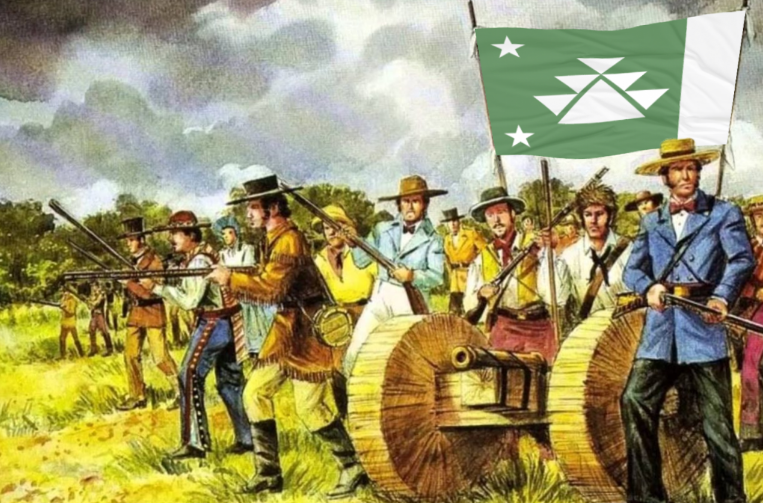
The Battle of San Guarda, 1846
In 1846, the people of San Guarda rose in open defiance against territorial claims that sought to divide the region between neighboring administrations. Long ignored and heavily taxed, settlers, ranchers, and local militias unified under a single banner to defend their land.
The decisive engagement, later known as the Battle of San Guarda, occurred on open plains near the central valley. Improvised artillery, volunteer riflemen, and mounted scouts held their ground against a larger, better-equipped force. After two days of fighting, the opposing command withdrew, marking the first recognized victory for San Guardan independence.
This conflict cemented San Guarda’s claim to sovereignty and led directly to its recognition as a distinct U.S. state later that year. The battle remains a symbol of unity, self-determination, and resistance.
The Quiet Decline
Following its admission as a state, San Guarda entered a long period of isolation. Its remote geography, limited infrastructure, and lack of industrial development gradually pushed it out of national relevance. Federal investment slowed, representation weakened, and population records became increasingly inconsistent.
By the late 20th century, San Guarda had largely vanished from public awareness. Administrative functions continued only in name, maintained through automated systems and legacy filings. Physical government offices closed, elections were rarely contested, and entire regions were quietly reclassified as inactive or unincorporated zones.
In the present day, San Guarda receives a single automated federal transfer once per fiscal cycle. The payment, totaling $23.14, is deposited without explanation, designation, or adjustment for inflation. No formal documentation clarifies its purpose, yet the transaction has continued uninterrupted for decades.
The state remains legally recognized, but functionally absent — a jurisdiction that exists on paper, sustained by a system that no longer remembers why.